Tuesday, March 22, 2011

More than half full -- the survivors

The basic message of this post: many survived and you can, too.

A couple years after the big Sumatra tsunami in 2004, I spent a long weekend on the coast of Oregon with a dear friend. I visit shorelines a lot as a coastal geologist, but I also love to visit them just for their subtle to spectacular beauty. When I am there, I do look around and think about what I will do and where I will go if I feel an earthquake. I also bring up the subject of tsunamis when I meet people on the coast, and ask them what their plan is. One man in this town said if he felt an earthquake he was going to “kiss his a— good-bye” (the idiom means to “give up and die”). I responded that he had an easy evacuation because there were hills right behind the narrow town along the beach.

Last night Tanioka-san and I had a chance to talk – he’s very tired from so much work, including trips to Tokyo to start reviewing what happened, and running a big public forum in Sapporo on Sunday. Yuichi was kind enough to answer some questions for me at the end of his day – it was after 8 PM when we met. We talked some science and then started reflecting on the people, both the victims and also the tsunami scientists who have been responsible for disaster planning and mitigation, and how terrible they feel. I think the hardest stories to hear are about residents in these towns who went up onto vertical evacuation structures and were washed away in some cases (not all), because the tsunami was bigger than anyone had planned for.

I said we need to tell the scientists and the planners involved that they did indeed save lives, many lives.

Tanioka repeated to me a story he heard about Kamaishi town. The children there had been trained to lead people to high ground. They did as trained, but when they watched the tsunami approaching, they realized that they were not high enough, so they led people to higher ground. All these people survived.

So let’s focus on the survivors. I look again at the grim statistics for number of dead and missing and then compare them to the vast number of refugees – the many many people who survived. Many of them survived because they had the knowledge and opportunity to do the right thing. It’s hard on the tsunami research community right now to feel the losses due to what didn’t go right, but let’s focus on what did go right, and how the next time it happens, the preparation and response of people at risk can save lives.


We learn these lessons by talking with survivors. Brian Atwater spearheaded a brochure that teaches some basic lessons, based on interviews with survivors from the giant 1960 Chile tsunami and elsewhere

English: http://pubs.usgs.gov/circ/c1187/ (below the main points with a little annotation from observations so far in 2011 Japan):

Spanish: http://pubs.usgs.gov/circ/c1218/

1) Many Will Survive the Earthquake – look at videos from Japan; little obvious damage before the tsunami arrival; afterwards, towns gone

2) Heed Natural Warnings – don’t wait for official warnings if you feel an earthquake, see strange water behavior, hear roaring water

3) Heed Official Warnings – just don’t wait for them if you sense any of the natural warnings and you are near the shore!

4) Expect Many Waves – some people in Chile died because they went back too soon. In Crescent City, CA, the largest wave is typically around #7, a couple hours after the first.

5) Head for High Ground and Stay There – see number 4

6) Abandon Belongings

7) Don’t Count on the Roads – can be earthquake damaged

8) Go to an Upper Floor or Roof of a Building if you cannot get to high ground.

9) Climb a Tree if you can’t get to a building

10) Climb onto Something that Floats if you can’t climb a structure – last ditch

11) Expect the Waves to Leave Debris

12) Expect Quakes to Lower Coastal Land

13) Expect Company – survivors will need to be sociable

14) This is my own addition – Much attention goes to the giant events we have had recently, but many tsunamis are not as large as these biggest ones, but still require your attention. It’s a cliché, but true—better safe than sorry.


Read the stories in this brochure, and read these stories about the survivors of Kesennuma City, trying to get back on their feet. Life does and will go on:

from 17 March: http://www.slate.com/id/2288248/

from 22 March: http://www.asahi.com/english/TKY201103210092.html


Right: Women walk through debris in Kesennuma, Miyagi Prefecture, northern Japan on Wednesday, March 16, 2011, after Friday's powerful earthquake-triggered tsunami hit Japan's east coast. Picture: AP Photo/Shizuo Kambayashi

Monday, March 21, 2011

Read and weep

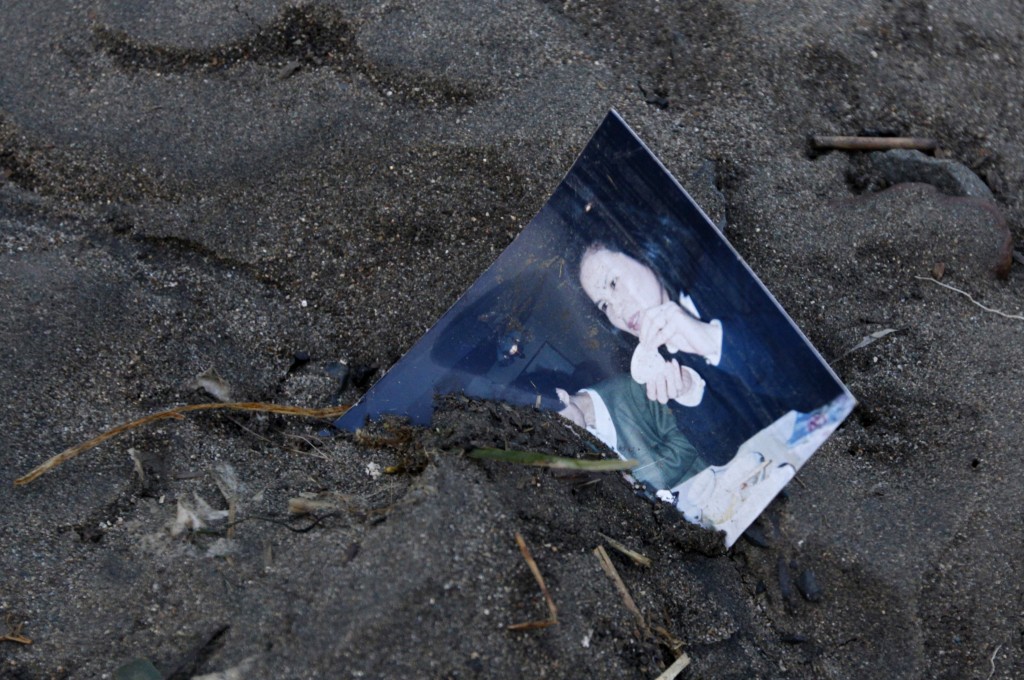
A family photograph is half buried in the sand and mud in Rikuzentakata, in Iwate prefecture, northeast Japan March 13, 2011. REUTERS/Lee Jae-Won

http://blogs.reuters.com/gregg-easterbrook/2011/03/15/japans-real-disaster/

Already the tsunami is old news. The nuclear reactor situation (which actually is tsunami news) is ongoing, the situation at least has not worsened for the last couple days, with some hopeful signs. Libya has been bombed.

It's the first day of spring, but it is still winter in northern Japan. Below is the latest bulletin from IOC/UNESCO summarizing the situation town by town.

I don't need iodine tablets, I need "heart" medicine.


IOC/UNESCO Bulletin No. 6

As of 21 March 2011

(Including summary of Bulletin No. 1 – 5)

Casualties by the Earthquake and Tsunami

As of 09:00z 21 Mar 2011

The National Police Agency

  • Dead: 8,649
  • Missing: 13,261
  • Road destruction: 1,703
  • Bridge destruction: 51
  • Railway destruction: 15

Number of Evacuees at each Prefecture;

· Aomori: 367

· Iwate: 45,468

· Miyagi: 131,554; including from Fukushima

· Yamagata: 3,858; including from Miyagi and Fukushima

· Fukushima: 131,665

· Tokyo: 546; From Miyagi and Fukushima

· Ibaragi: 3,928; including from Fukushima

· Tochigi: 3,0688; including from Fukushima

· Gunma: 2,983; including from Fukushima and Miyagi

· Saitama: 3,729; under survey

· Chiba: 1,220; including from Fukushima and Miyagi

· Kanagawa: 252; from Fukushima

· Niigata: 7,849; from Fukushima

· Yamanashi: 457; from Fukushima and Miyagi

· Nagano: 193; from Fukushima

· Shizuoka 163; from Fukushima

As of 05:00Z 21 March 2011

The Japanese Fire and Disaster Management Agency (FDMA)

  1. Dead: 8,019 persons
  2. Missing: 10,512 persons
  3. Injured: 2,928 persons
  4. Fires: 326 events (325 fires were already extinguished)
  5. Number of evacuees: 312,792

(Note: Numbers are based on the report from each Prefecture)

C: City, T: Town, V: Village

Local G: Information is taken from web of each municipality

Prefecture

City, Town, Village & Population

dead

missing

Note: Tsunami related disaster

(Whole area / inundation area in km²)

Hokkaido

Hakodate C

294,264

1


Local G

  • One man dead by drowning
  • 128 houses flooded
  • 5 fishing boats; sinking
  • Flood area; Benten, Suehiro, Toyokawa, Oote, Wakamatsu, Kaigan, Minato-Chou

Aomori

Hachinohe C

241,308

1

1

305 / 2

(FDMA)

  • Wide-area are inundated


Misawa C

42,226

2


Local G

  • 30 houses: flood
  • Evacuation shelter was closed 15 March


Hashikami T


94 / 0.5

Iwate


  • JR Train stop: Tohoku-Akita shinkansen, Ofunato, Kitagami, Kamaishi, Yamada lines etc ( Recovering; no prospect)


Miyako C

59,118

287

1,700

1,260 / 9

(FDMA)

  • Severe tsunami damages
  • More than 10 villages are completely destroyed


Ofunato C

40,801

222

191

323 / 6

(FDMA)

  • More than 300 houses flow out
  • Many houses are flooded
  • 3,498 houses are completely destroyed
  • Especially Suesaki and Hosoura regions are severely damaged.
  • No communication system


Kuji C

36,651

3

2

623 / 4

Local G

  • 145 houses are destroyed
  • 572 boats; damaged


Rikuzen-Takata C

23,243

741

1,734

232 / 9

(FDMA)

  • Extremely severe damages
  • Widely inundation
  • No communication system
  • 3,600 houses are damaged


Kamaishi C

39,294

495

580

441 / 7

(FDMA)

  • Coast-Guard building inundated up to 2nd floor
  • Fire Office building is flooded
  • No communication system


Otsuchi T

15,293

418

732

201 / 4

Ogasawara; Iwate U. (14 Mar)

  • Whole town is severely damaged
  • No communication system


Yamada T

18,745

369

Un-known

263 / 4

  • No communication system


Iwaizumi T

10,693

5

2

993 / 1

  • No communication system
  • 40 houses are flooded


Tanohata V

3,836

13

27

(FDMA)

  • 249 houses flow out
  • 148 houses are destroyed
  • No communication system


Fudai V

3,094


5

70 / 0.5

(FDMA)

  • Ootanabe and Horiuchi fishing ports are severely damaged.


Noda V

4,639

31

20

81 / 2

  • Tsunami flow over the village government building
  • Severe damage in the central village
  • 400 houses in the Motomura District are severely damaged
  • No communication system


Hirono T

17,961


303 / 1

Local G

  • No dead
  • 3 houses; flooded
  • 98 fishing boats: flow out or damaged
  • JR train bridge collapsed

Miyagi

Sendai C

1,046,902

54

9

(FDMA)

  • 295 bodies are recovered (Not included in this table yet)
  • 296,323 houses: power cut as of 17 March


Sendai-Miyagino


58 / 20


Sendai - Wakabayashi


48 / 29


Sendai- Taihaku


228 / 3


Ishinomaki C

160,336

1,826

1,472

556 / 40

(FDMA)

  • Wide areas are inundated. Difficult for rescue work


Shiogama C

56,325

13

40

18 / 5

Local G


Kesennuma C

73,239

443

529

333 / 15

(FDMA)

  • Many people are isolated due to inundation of wide area


Natori C

73,576

493

Under survey

100 / 27

(FDMA)

  • Many areas are inundated


Tagajo C

62,881

82

Under survey

20 / 6


Iwanuma C

43,921

120

Under survey

61 / 29


Higashi-Matsushima C

42,859

577

429

102 / 36


Watari T

34,773

188

200

73 / 35

Local G


Yamamoto T

16,695

362

465

64 / 24

Local G

  • Evacuation Order is issued at 05:52 from local G.
  • Major tsunami attacking around 06:30 Z


Matsushima T

16,193

1

31

54 / 2


Shichigahama T

20,377

44

49

13 / 6

Local G

  • Tsunami height was more than 10 m
  • All facilities along coast were completely destroyed
  • No communication system


Rifu T

9,768

1

0

45 / 0.5

  • Tsunami sediment in Hamada and Suga district is about 3 cm thicknesses.


Onagawa T

9,965

181

498

(FDMA)

  • About 630 people need to be rescued
  • Many areas are inundated


Minami-Sanriku T

17,382

398

Under survey

164 / 7

(FDMA)

  • Many areas are inundated

Fukushima

Iwaki C

345,310

201

4

Local G

  • Tsunami severely damaged area; from Kunohama to Onahama district
  • Some areas of above are completely destroyed


Souma C

37,919

105


198 / 29

(FDMA)

  • Severe tsunami damages


Minami-Souma C

70,971

214

1,260

399 / 27


Hirono T

5,383

2

1


Naraha T

7,847

3

10


Tomioka T

15,755

2

8


Okuma T

11,264

1

8


Futaba T

6,917

1

14


Namie T

20,686


270


Shinchi T

8,306

61

107

46 / 11

Ibaragi

Kita-Ibaragi C

5

1

Local G

  • Some houses; flooded


Hitachi C

0

0

Local G

  • 35 houses: completely destroyed by tsunami, and 50 houses: partially destroyed, 556 houses; inundation
  • Tsunami damages at Kawajiri, Aise, Kawarako and Kujihama Ports.


Oarai T

18,188

1


Local G

  • About 2,000 houses; flooded


Kamisu C


Local G

  • 5 houses flooded
  • 2 vessels: capsizal
  • 1 vessel: stranding
  • 12 boats: sinking
  • 5 boats: stranding on shore

Chiba

Choshi C

0

0

Local G

  • 32 houses flooded


Asahi C

12

3

Local G

  • 112 houses flooded
  • 254 houses were completely destroyed by tsunami
  • 537 houses were partially destroyed by tsunami
  • 85 houses were completely destroyed by earthquake
  • 772 houses were partially destroyed by earthquake


Sousa C


Local G

  • 18 houses flooded


Yokoshiba-Hikari T


Local G

  • 14 houses flooded
  • Boats are damaged
  • Port facility is damaged


Sanbu C

1


Local G

  • 243 houses flooded


Kujyukuri T


Local G

  • 161 houses flooded


Oami-Shirasato T


Local G

  • No tsynami damage


Shirako T


Chousei V


Ichinomiya C

0

0

Local G

  • 58 houses flooded; Kaigan and Omura District
  • Farm: 3 ha inundated


Isumi C


Local G

  • 19 houses flooded


Onjyuku T


Katsuura C


Kamogawa C


Minami-Bousou C


Tateyama C


Chiba C


Local G

  • 2 houses flooded

Shizuoka

Shimoda C

25,549


Local G

  • 13 houses; flooded